


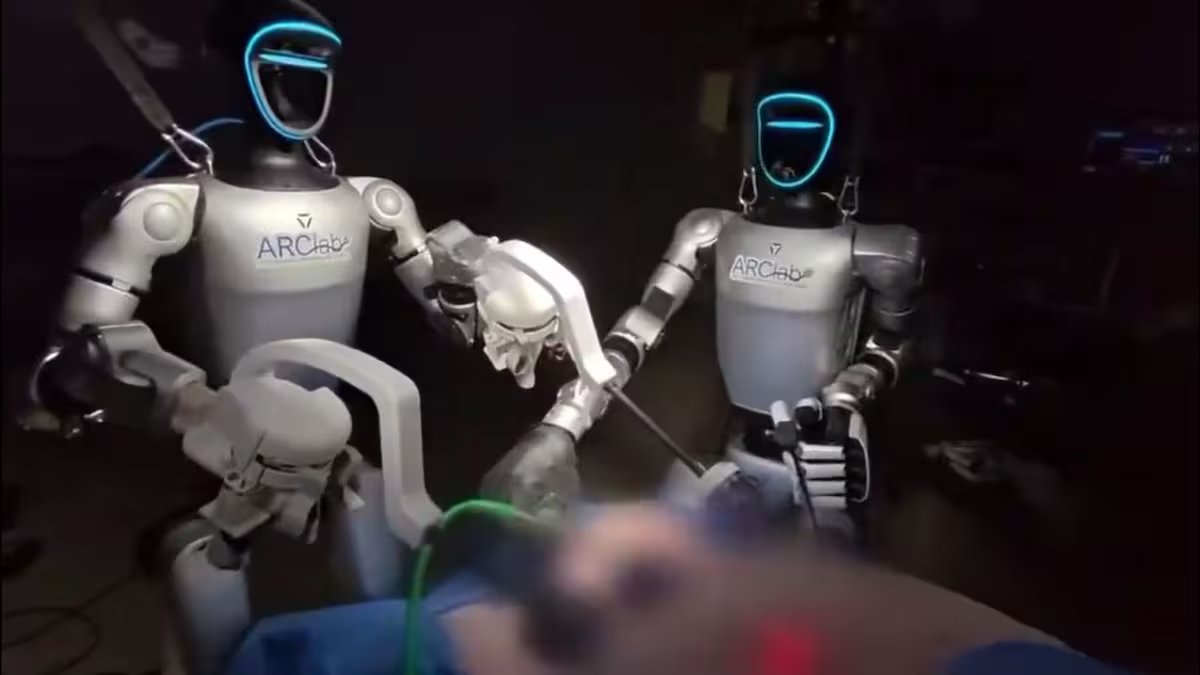
The findings were published in the journal Nature on July 8 in an article titled “In vivo feasibility study of humanoid robots in surgery”. The study was carried out by engineers and surgeons from the University of California San Diego.
Two successful surgeries completed
The research team conducted two gallbladder removal procedures on pigs. In the first operation, the humanoid robot performed the surgery with assistance from a surgeon, while the second procedure was completed entirely with the help of two humanoid robots working together.
The successful procedures mark an important milestone in evaluating the technology before it is tested on humans. Speaking with ABC News, Dr Ryan Broderick, interim director of the Center for the Future of Surgery at UC San Diego, said, “As a proof of concept, it absolutely worked.”
‘Surgie’ designed to work in compact operating rooms
The humanoids
Robots, nicknamed ‘Surgie’, are equipped with a head and arms and occupy far less space than robotic surgical systems currently used in hospitals.
Broderick said the robots function like bedside assistants and “fit into the space that we’re traditionally used to being in for laparoscopic surgery.”
Could help address staffing shortages
The research team also said humanoid robots may help ease pressure on hospitals by supporting surgical teams and increasing the number of procedures that can be performed.
Michael Yip, a professor at UC San Diego, said the successful surgeries demonstrated that humanoid robots can safely perform real operations in an operating room that can save lives.
Potential beyond traditional hospitals
Researchers believe the humanoid robot could eventually be deployed beyond hospital operating rooms. According to Dr Shanglei Liu, a colorectal surgeon at UC San Diego, the technology could help expand access to surgical care in remote and smaller operating areas.
“You can imagine this device being deployed on a ship, in a village somewhere, in a smaller operating environment that’s not in major cities. And it opens up, I think, a lot of doors for access,” added Liu.