

Those platforms still matter. But the nature of warfare is changing.
A modern military system is increasingly defined not only by the platform itself, but also by the sensors, software, data, artificial intelligence, communications and electronic warfare capabilities that enable it.
That raises a larger question for India: as warfare becomes increasingly software- and data-driven, how can the country build military systems that it not only manufactures, but also fully understands and controls?
The answer is beginning to reshape India’s defense technology strategy.
Chandrika Kaushik, Director General, PC&SI, DRDO, told CNBC-TV18 that technology was becoming deeply embedded in modern defense, with AI increasingly being integrated into platforms and systems under development.
Why the battlefield is becoming a technology contest
A fighter aircraft or a missile is still a physical platform. But its military effectiveness increasingly depends on what happens beyond its physical structure.
Sensors collect information. Communications systems transmit it. Software processes it. AI can help identify patterns and threats. Command-and-control systems help decision-makers respond. Electronic warfare systems can disrupt an adversary’s communications or sensors.
The result is that military capability is increasingly becoming a combination of hardware, software, data and connectivity.
This is particularly important in electronic warfare, where the ability to detect, analyze and control the electromagnetic spectrum can influence what an adversary can see, communicate with or operate.
“Whoever controls the spectrum controls the war,” Kaushik said, highlighting the growing importance of electronic warfare.
The change can be seen in India’s Airborne Early Warning and Control system, Netra. The aircraft platform itself continues to depend on a foreign original equipment manufacturer, but the mission systems, logic and intelligence embedded within the platform have been developed using indigenous technology.
That distinction is becoming increasingly important.
Defense sovereignty is no longer simply about manufacturing the physical platform. It is also about controlling the technology that makes the platform intelligent.
What does sovereign AI mean in defense?
Artificial intelligence is increasingly being used to process large volumes of data and assist military systems. But simply using AI does not necessarily mean a country controls the technology behind it.
For defense applications, the question is: who controls the algorithms, the data used to train them and the software infrastructure on which they operate?
Kaushik said DRDO was working to ensure that the algorithms, datasets used for training and software stacks developed for defense applications were homegrown.
“If you control the software stack, you control the data on which you are training your algorithms,” she said.
This matters because an AI system is shaped by the data on which it is trained. If critical military AI systems depend on external datasets, foreign software or technologies that cannot be independently modified, the country using them may have limited control over how those systems evolve.
There can also be implications for cybersecurity, system upgrades, interoperability and the ability to adapt technology to changing battlefield conditions.
That is why DRDO has developed software development guidelines, verification and validation processes, as well as a framework for evaluating AI stacks.
The broader objective is to ensure that critical defense systems are not merely imported as finished products, but are built on technologies that India can understand, modify and maintain.
Why AI is moving closer to the battlefield
Another major change in defense AI is the movement of intelligence away from centralized systems and towards the point where data is generated.
This is known as AI at the edge.
In a conventional model, a sensor may collect information and send it to a central location for processing. An AI system at the edge, by contrast, can process data directly on a sensor, vehicle, aircraft or other platform.
This can be critical in military operations.
A battlefield may have limited connectivity. Communications networks may be disrupted. Sending every piece of data back to a central command center can also create delays.
Processing information locally can therefore allow a system to respond faster and continue operating even when connectivity is unreliable.
For example, a sensor equipped with AI could potentially identify patterns or classify objects closer to where the data is generated, rather than waiting for all information to be transmitted elsewhere for analysis.
Kaushik said DRDO was increasingly looking at integrating AI across defense systems and placing AI capabilities directly on platforms and sensors so that they could operate in field conditions.
The significance of this shift is that AI is moving from being a back-office analytical tool to becoming part of the operational equipment used on the battlefield.
The difficult question: who makes the decision to fire?
As AI systems become more capable, they also raise a fundamental question: how much decision-making should be delegated to machines?
This is particularly important when autonomous systems have the ability to use lethal force.
The debate is taking place globally around lethal autonomous weapon systems. At the center of the debate is the question of human control.
A human can be “in the loop”, where a person makes the final decision before a system takes action.
A human can also be “on the loop”, where an autonomous system operates independently but a person monitors its actions and may be able to intervene.
The distinction matters because the speed of modern warfare may increasingly exceed the time available for humans to analyze every piece of information manually.
At the same time, delegating decisions involving lethal force to autonomous systems raises legal, ethical and operational questions.
Kaushik said India’s position was that safeguards and guardrails were needed for autonomous systems with lethal capabilities.
“We need to have a human in the loop for the final command for any lethal action,” she said.
This creates a difficult balance.
Military systems may need to operate at machine speed, but the final responsibility for the use of lethal force may still need to remain with a human operator.
The challenge could become more complex if different countries develop and deploy autonomous systems according to different standards of human control.
Why India needs more than one defense research organization
The shift towards AI, software and autonomous systems is also changing how defense technology needs to be developed.
India’s traditional defense research model was largely built around government research institutions developing technologies that were subsequently manufactured by public-sector companies.
But modern technologies are evolving too quickly and are too complex for a single organization or a small group of institutions to develop every capability on its own.
The emerging model is therefore more distributed.
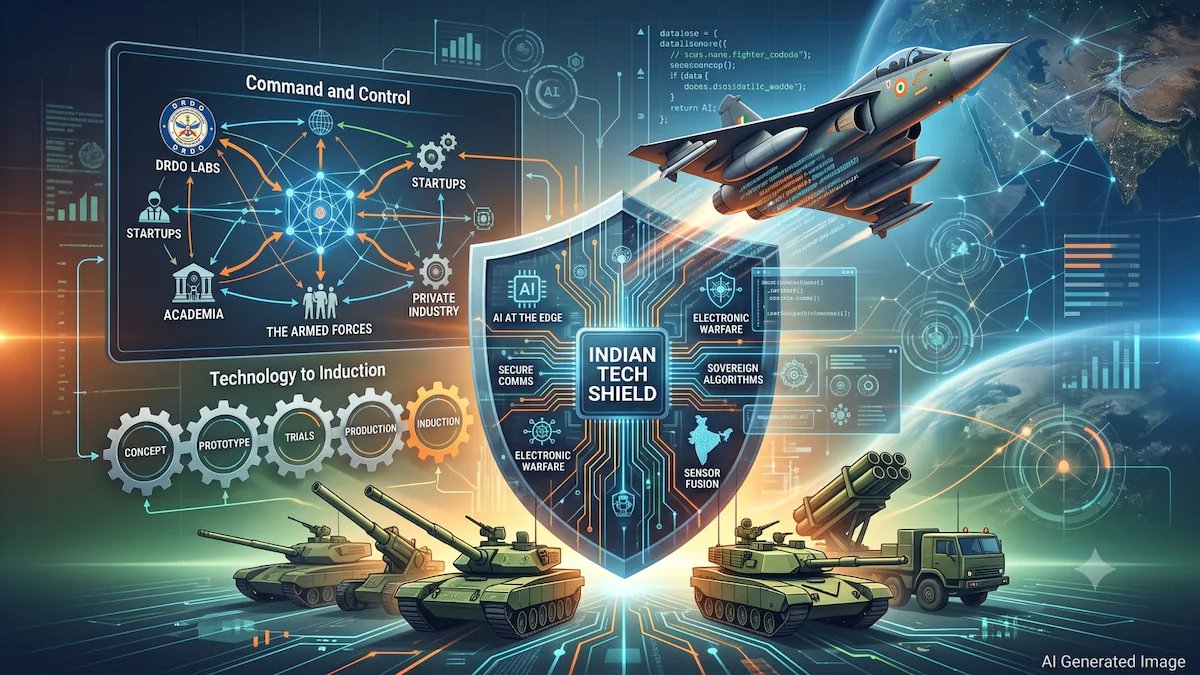
It involves:
- DRDO laboratories
- Startups
- Private-sector companies
- Public-sector organizations
- Academic institutions
- The armed forces
The Technology Development Fund, the iDEX program and other indigenous development initiatives are part of this broader innovation ecosystem.
The logic is relatively straightforward. Startups may be able to develop new software or AI capabilities quickly. Established companies may have the manufacturing scale required for production. DRDO may possess deep expertise in specialized defense technologies. The armed forces bring knowledge of operational requirements.
The challenge is to connect these capabilities effectively.
Why developing a prototype is not enough
One of the biggest problems in defense technology is the gap between developing a prototype and producing a system at scale.
A prototype demonstrates that a technology can work. It does not automatically demonstrate that the system can be manufactured reliably, maintained over its operational life or produced in the quantities required by the armed forces.
The transition involves several stages:
Technology development → prototype → user trials → design changes → productionisation → manufacturing at scale → induction
At each stage, new problems can emerge.
A design may need to be modified after trials. Components may need to be redesigned for mass production. Manufacturing capacity may not yet exist. Quality assurance processes may need to be established. A production partner may not have been involved during the original development process.
This can create a significant delay between a technology being developed in a laboratory and its eventual deployment by the armed forces.
DRDO has attempted to address this by linking development more closely to the acquisition and production process.
For major mission-mode projects, clarity on the likely quantities to be induced is established earlier. An industry development-cum-production partner can then work with the DRDO laboratory from the beginning.
This allows the industry partner to participate in concurrent engineering rather than entering the process only after the prototype has been completed.
The idea is to ensure that the system being developed is not only technically functional, but also designed with large-scale production in mind.
Production facilities and integration capabilities can also be established earlier, helping reduce the time between development, trials and induction.
The larger lesson is that defense innovation is not complete when a laboratory produces a working prototype. The technology has to survive the much more difficult transition from demonstration to dependable military capability.
What this means for India’s defense strategy
The transformation of warfare is therefore not simply about adding AI to existing fighter jets, tanks or missiles.
It represents a broader change in how military capability is defined.
A modern defense system increasingly combines:
- A physical platform
- sensors
- Communications
- software
- data
- AI models
- electronic warfare
- cyber capabilities
- Command-and-control systems
The country that controls these layers has greater control over its military capability.
For India, the strategic challenge is twofold.
First, it needs to develop critical technologies domestically, particularly in areas such as AI, software, sensors, communications and electronic warfare.
Second, it needs an ecosystem that can move these technologies quickly from research and development to reliable, large-scale production.
This does not mean that conventional military platforms are becoming irrelevant. Fighter jets, tanks, missiles and warships will remain central to military operations.
But their effectiveness will increasingly depend on the technology built around them.
The future of warfare is therefore unlikely to be a choice between hardware and software. It will be about how effectively the two are integrated.
For India, the strategic objective is increasingly clear: build not just the platforms that fight a war, but also the indigenous technology stack that makes those platforms intelligent, connected and capable of operating with greater autonomy.
That shift—from building military hardware to controlling the technology ecosystem behind it—could become one of the most important changes in India’s defense strategy for the future of warfare.