

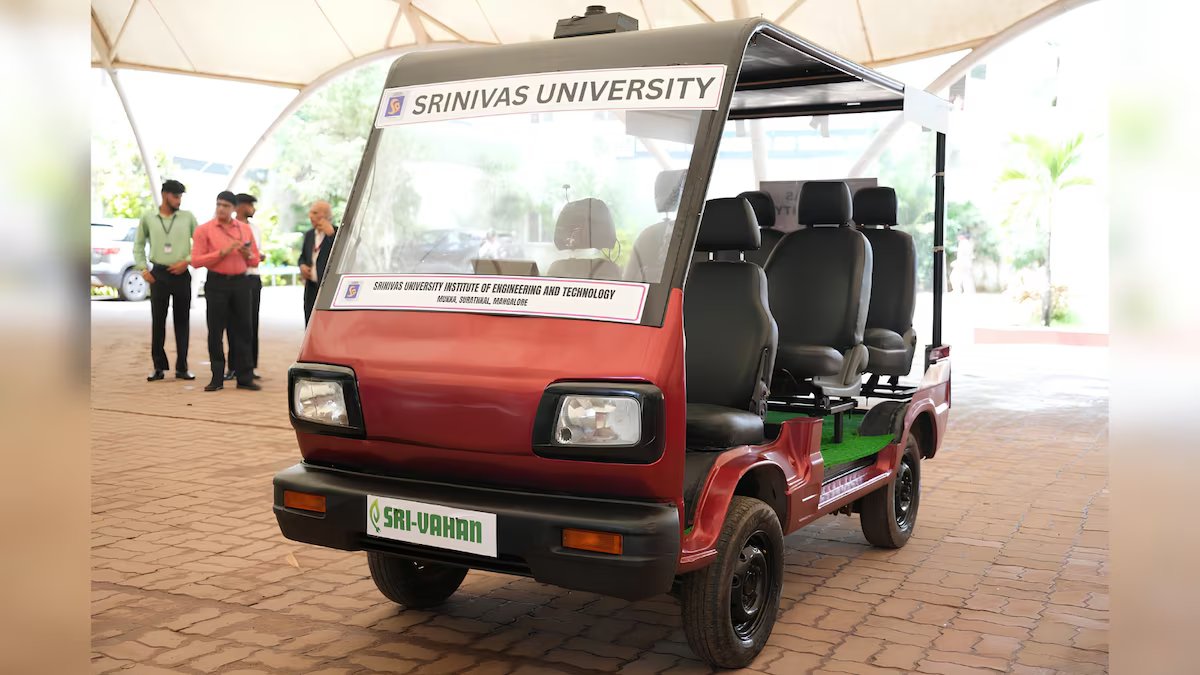
The vehicle was officially unveiled on July 23, 2026. It is not just a student project but a working prototype that could eventually be developed for real-world use.
Rather than building a vehicle from scratch, the team retrofitted an existing car, converting it into an electric, AI-driven autonomous vehicle. The entire prototype was developed in about six months at a cost of roughly ₹4-5 lakh.
How it “sees” the road
The vehicle runs on artificial intelligence combined with LiDAR, a camera-based vision system, GPS navigation, ultrasonic sensors, odometry, Visual SLAM, and sensor fusion technology. Together, these allow the vehicle to travel safely along a pre-mapped route without a driver.
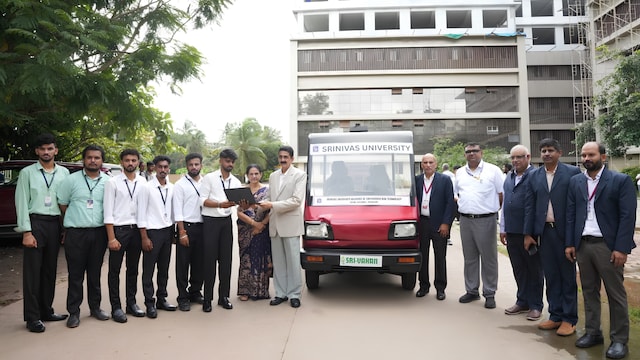
Students and faculty of Srinivas University Institute of Engineering and Technology, Mangaluru, pose with ‘Sri-Vahan’, the AI-powered driverless electric vehicle.
If a person or obstacle appears in its path, sensors detect it and bring the vehicle to an automatic halt. Operators can also monitor the vehicle through its onboard camera and control it remotely if needed. The vehicle additionally comes fitted with an AI assistant system.
Speed and range
For safety during the testing phase, the vehicle’s speed has been capped at 5 km/h in autonomous mode. In manual mode, it can travel between 20 and 28 km/h. It is powered by a 5-kilowatt lithium-ion battery and can cover 15 to 22 km on a single full charge.
The vehicle can carry a load of about 360 kg, meaning it can seat six people or carry an equivalent weight of cargo. It has also been designed so it can be converted into an ambulance if required.
Where it could be used
The vehicle has been designed with several potential applications in mind: ferrying students across educational campuses, transporting staff within industrial areas, moving patients within hospitals, functioning as an ambulance, carrying supplies into high-risk zones in military areas, and supporting remote-controlled defense operations.
What’s next
Currently, the vehicle navigates only along pre-mapped routes. In the next phase, the team plans to add self-navigation capability for unmapped areas and fit a higher-capacity battery, with the eventual goal of turning it into a fully functional ambulance.
The institution also aims to build in an autonomous driving system suited to Indian road conditions and eventually commercialize the technology.
‘Sri-Vahan’ demonstrates that older vehicles can be converted into low-cost, AI-powered autonomous vehicles using existing technology, even as global companies like Tesla pursue similar goals with far larger budgets.
The project reflects the research capability of the students, offers practical hands-on learning, and marks a step towards developing autonomous technology suited to Indian conditions.
The project was guided by Prof Vishwas C Shetty of the Mechanical Engineering department, with Research Associate Vishakh Menon heading research and development. Students Shreyas, Adwitiya, Ujwal, Akshay, Manjunath and Prakhyat were key contributors to the project.
According to Dr A Srinivas Rao, Chancellor of Srinivas University, such research gives students the confidence to tackle future technological challenges while also playing an important role in finding solutions to real-world problems faced by society.