


“My model scored higher.” “Mine has a bigger context window.” “Our reasons are better.” “And we just raised another few billion dollars.”
Every few weeks came another launch—a smarter model, a faster model, a model that could code, draw, reason, search, plan and probably remind you to call your mother. The race was simple: build the smartest AI.
That race isn’t over. But another one has quietly begun. And it may end up being far more important. Because boardrooms are no longer asking, “How intelligent is your AI?” They’re asking something much less glamorous: “How much money will it make—or save—us?”

It’s a subtle shift. But it’s the kind that changes industries.
Remember when the internet was all about page views? Eventually, it became about profits. Remember when cloud computing was about shiny new infrastructure? Eventually, investors cared more about recurring revenue than server capacity.
Smartphones followed the same script. At first, it was all megapixels and processor speeds. Then the winners became the companies that built ecosystems people couldn’t live without. AI seems to be entering that phase. The excitement around capability hasn’t disappeared, but increasingly, capability alone isn’t enough. The conversation is moving from intelligence to economics.
One deal this week captured that shift rather well. HCLTech signed a $1.14 billion agreement with a Europe-headquartered Fortune Global 50 company to build an AI-driven operating model for its digital workplace and enterprise network.
The contract runs until December 2031 and, importantly, is not a renewal or an extension. It’s entirely new business. That distinction matters. For much of the last two years, AI announcements revolved around pilots, proof-of-concepts and experiments. This is not an experiment. It’s a company committing billions of dollars and several years to embedding AI into the way it actually runs its business. That’s a very different conversation.
Once companies move from experimentation to deployment, they begin asking questions engineers don’t usually enjoy hearing. What’s the return on investment? What’s the cost? Can we achieve the same outcome for less?
Which brings us to one of the more interesting debates in AI today. Palantir CEO Alex Karp recently took aim at the token-based pricing models used by frontier AI companies like OpenAI and Anthropic.
On the surface, it sounded like a pricing debate. It really wasn’t. It was about how businesses think. Developers may obsess over tokens because that’s how large language models process information. Chief financial officers see something else: another line item on the expense sheet. As AI models become more powerful—and more expensive to run—companies are beginning to ask a fairly old-fashioned question: Does spending twice as much on AI actually produce twice the business value?
Karp argued that many enterprises are increasingly comfortable using open-weight models if they deliver similar outcomes at a lower cost. That’s not a debate about technology. It’s a debate about economics. And economics usually wins.
The shift isn’t changing only how companies buy AI. It’s changing who they hire. One job title that’s suddenly getting a lot of attention is the Forward Deployed Engineer, or FDE. Think of them as translators—part engineer, part product manager, part AI architect.
Their job isn’t simply to build AI. It’s to walk into a customer’s business, understand what’s broken and figure out where AI can actually make a difference. Speaking to CNBC-TV18, Fundamentum co-founder Sanjeev Aggarwal argued that India could become a global hub for this talent.
‘India can be the FDE factory for the world.’
What is a Forward Deployed Engineer (FDE) and why is it becoming AI’s hottest new job?
Speaking to Shereen Bhan on Young Turks Reloaded, Fundamentum Co-founder Sanjeev Aggarwal says FDEs combine the skills of an engineer, product… pic.twitter.com/VYA8JUV0ln
— CNBC-TV18 (@CNBCTV18News) July 3, 2026
The logic isn’t hard to follow. India has spent decades building expertise in IT services, enterprise software and technology implementation. Those capabilities may prove just as valuable in the AI era as they were during previous technology cycles.
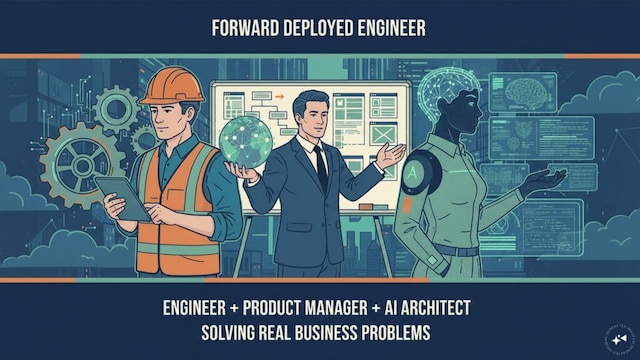
Aggarwal even believes AI-native companies built around FDEs could generate far more revenue with much smaller teams than traditional IT services firms. Whether that prediction comes true is anyone’s guess.
But it does raise an interesting question. Maybe India’s biggest AI opportunity isn’t building the next frontier model. Maybe it’s becoming the country that helps the rest of the world actually use them. That would be a very Indian success story—not necessarily inventing every technology, but becoming indispensable in deploying it.
The investment world seems to be arriving at a similar conclusion. Startup funding in India plunged to $165.8 million across 22 deals during the week ended July 2, after topping $1 billion the previous week, largely thanks to CRED’s fundraising.
Weekly funding numbers can be noisy. One giant check can make an entire ecosystem look healthier than it really is. But beneath the volatility, investors increasingly appear to be asking tougher questions. Who’s paying? Who’s using the product? Can this become a real business? Innovation still matters. Commercial viability matters more. And that’s probably where AI is headed too.
Don’t get us wrong. The frontier model race is alive and well. OpenAI, Anthropic, Google, Meta and everyone else will continue chasing smarter, faster and more autonomous AI. Those breakthroughs still matter. But for enterprises, the real competition may increasingly lie elsewhere. Who can deploy AI at scale? Who can integrate it into everyday operations? Who can keep costs under control? Who can show measurable results instead of impressive demos? In other words, who can turn intelligence into value?
The first phase of the AI revolution was about convincing the world that artificial intelligence could do extraordinary things. The next phase is about proving those extraordinary things are worth paying for. And that may turn out to be the battle that decides the real winners.