


The company expects demand recovery in the second half of the year to support operating leverage and improve profitability.
While the company has seen minor delays in deal closures in West Asia due to geopolitical tensions, he noted that the region contributes only a small portion of overall business and the impact is manageable.
Hexaware expects the margin pressure seen in the first half to be temporary as several newly won deals currently involve onboarding and re-badging employees across geographies. According to R Srikrishna, margins are expected to improve gradually as workforce realignment progresses and growth accelerates.
The company is also stepping up investments in AI capabilities, platforms and solution architecture, while keeping an eye on acquisitions that strengthen its AI-focused offerings.
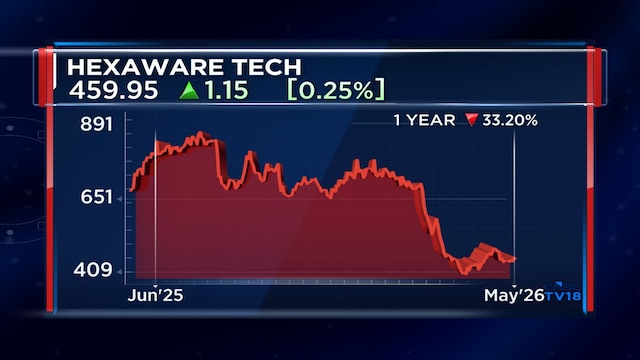
In the January–March quarter (Q1CY26), Hexaware Technologies reported dollar revenue of $388.5 million, an EBIT margin of 13%, and net profit of ₹351.60 crore.
These are edited excerpts from the interview.Q: What is giving you that optimism that you can do better than 7.50% for this year? The start of the year has been a little bit softish, but you had alerted us that there will be a couple of seasonally weak quarters, although you have gone ahead and won a couple of deals as well, which will be part of the GSE account, is what I am talking about. What is giving you that optimism that things will recover from here on, and do you stick to that 7.6% growth for the year?
A: As you rightly said, whatever you saw as numbers for us, there are two things. One, it’s seasonality. Two, it is still better than what we expected, both on revenue and profit. A lot of the confidence for us comes from deals that we won late last year and during this quarter. It’s actually a countless number of deals, but we called out eight in our investor call earlier today, and it’s a combination of those deals and continued momentum on new wins that gives us the confidence.
Q: That GSE account, that’s the Fannie deal that you have won, and you have announced it in the presentation how much will that contribute to this year’s revenue? If you could help us out with that number?
A: That client in the last year has declined like 45%, so we had a lot of headwinds. What we have said is that we will have stability. Now we are not necessarily seeing growth, but we have said we will have stability. There could be a small plus or minus, but that’s the normal course of business. The growth will come from all the other deals that we have won.
Q: Give us a sense on the DSO as well, because that expanded as compared to what it was earlier and what do you think explains that and where does that settle?
A: At 74 days, we are the best in the industry. It has gone up from 67 last quarter, but 67 at that time, we called out, was not a sustainable watermark. It is still the best in the industry. It’ll be about this level going forward.
Q: Any delays in the closure of deals, because, DSO, we understand that it can be at around 75 even though it’s best in class. Are there any delays in the closure of deals? Because that would impact business.
A: There is some marginal delay in the West Asia because of the war, but ultimately that’s only 2% of our business. So yes, there are delays there, but we will make up for it elsewhere.
Q: Your adjusted EBIT margin is tracking at around 13%. That’s a little lower than the guidance, but you’ve guided that the second half will be far better? Give us a number and what are the triggers in place?
A: We guided at the beginning of the year for 13% to 14%. We said the first quarter will be materially lower than 13%. We did quite a bit better in the first quarter than what we had assumed.
We also said, not only will the year be at 13% to 14%, we will exit the year at a higher rate than the full-year average. The reasons are twofold. First is, in the first half of the year, there’s a number of deals where we are onboarding and re-badging client staff. Now, those kinds of deals are margin dilutive at the beginning, because the talent is in the wrong geographies. Now, through the later half of the year, we will rebalance that talent in a more globally distributed way, and as we do that, our margins for those deals will improve.
Second, as growth comes back, our operating leverage will kick in. Our investments have been front-loaded, in quarter four of last year, and in this quarter, and will continue a bit in quarter two. We haven’t changed our investments because we expect growth in the second half. This will result in operating leverage.
Q: What about the cash, $220 million in your books? What do you plan to do to deploy that? Any sort of AI-related investments, acquisitions that we can hear about, or maybe just give back some part of it to shareholders as a buyback or dividend?
A: We already have a pretty strong dividend payout. Last year we paid out about 50% of our profits, or 51% of our profits, as dividends. This cash is after that. We pay out plenty. We will continue to look for acquisitions. But the fact is that, as a consequence of AI, the organic investments are higher than before, whether it is in solution architecture, whether it’s in platforms, or building new sets of capabilities, our organic investments are higher. We will also be alive to acquire opportunities. But frankly, the way we are thinking about acquisitions now has changed.
Virtually every historic deal we think of as legacy services. Our future acquisitions will be very sharply focused on AI capabilities, but there aren’t too many of those right now in the market.
For full interview, watch accompanying video

Follow our live blog for more updates on Q4 results