

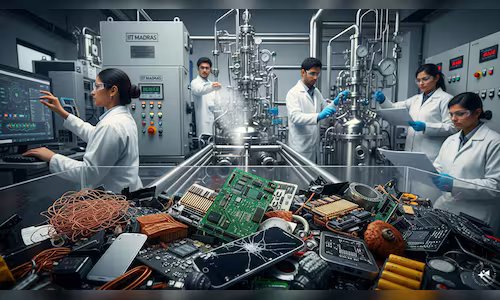
The pilot plant facility is designed to treat 100 tonnes per annum of PCB and is located at Bharat Heavy Electricals Limited (BHEL) in Tiruchirapalli, an IIT Madras release here on Sunday said.
It processes bare-printed circuit boards (PCBs), one of the most hazardous and metal-rich components of electronic waste. PCBs contain significant quantities of copper, lead and tin, metals that otherwise leach into soil and groundwater if e-waste is not handled properly, posing long-term environmental and public health risks.
From lab-scale chemistry to a functional unit, this innovation demonstrates a zero-discharge, single-acid process to recover metals from electronic waste, offering a scalable blueprint.
At a time when India is generating nearly five million metric tons of electronic waste annually, IIT Madras researchers have built and demonstrated a scalable, zero-discharge pilot plant that can recover valuable metals from discarded electronics—without polluting soil, water, or air.
The technology behind this pilot project was the outcome of an exploratory research project funded internally by IIT Madras.
Elaborating, Professor S Pushpavanam, YBG Varma Chair Professor, Department of Chemical Engineering, IIT Madras, said, “With India’s e-waste challenge accelerating, this pilot plant offers a ready-to-scale model for clean metal recovery. The work aligns with Make in India, the circular economy, and critical minerals security. It also provides a rare example of academic research translating into technology development.” He said the unique aspects of this pilot plant, in comparison to existing technologies, include use of a single acid, enabling a zero discharge process, made completely by Indian firms based on research in IIT Madras and automated operations with high levels of safety integrated in the design.
Also Read: Vaishnaw expects more companies to start production of memory chips in India