


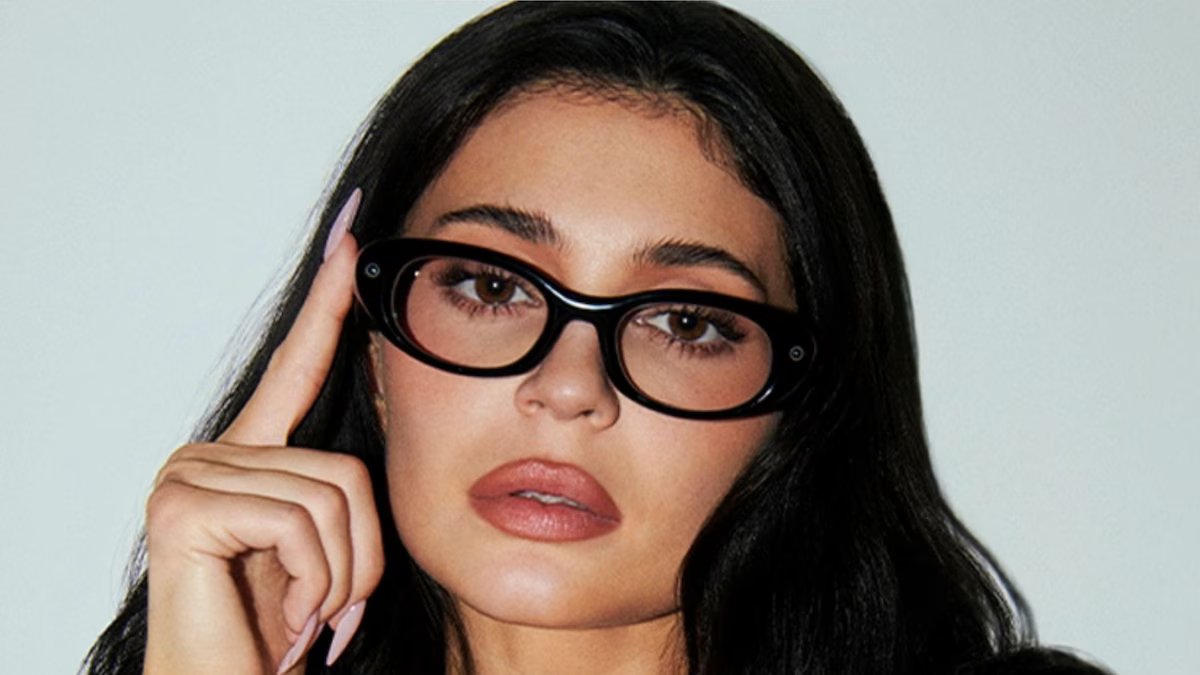
We watch through her eyes, via $399 lenses she helped design, as she directs a staff member on the placement of a statue and leaves through a rack of clothes. It ends on a pixelated image of Jenner’s face, the visual shorthand media has long used for nudity or privacy redaction, wearing the glasses that, per the ad, will never make you look like you’re wearing a camera.
The It-Girl-ification of a surveillance device
Smart glasses have existed, in various clunky forms, since Google Glass made “glasshole” a slur in 2013. What’s changed isn’t the technology so much as the styling. According to a Forbes India report, Meta now controls roughly 80% of the AI glasses market and moved more than 7 million units of its Ray-Ban Meta line in 2025 alone.
The category is projected to blow past $30 billion by 2030, according to the 2026 State of Fashion report from McKinsey and The Business of Fashion, which frames “style-conscious” AI eyeglasses as the format most likely to eventually make wearable computing a mainstream habit rather than a gadget-store curiosity.
For years, the pitch for smart glasses was functional: hands-free navigation, translation, notifications. The pitch now is about making the hardware desirable first and useful second. Jenner’s involvement is the clearest expression of that pivot, where a beauty and lifestyle billionaire brought in specifically to make surveillance hardware read as jewelry rather than equipment.
Surveillance capitalism, dressed for the party
The term “surveillance capitalism,” coined by scholar Soshana Zuboff, describes an economy which benefits from extracting behavioral and personal data, often without consent, and convert it into predictive products sold back to advertisers. Smart glasses, a device that turns the wearer’s entire field of vision and everything within earshot into potential training data, turns out to be a great tool for this business model.
A February 2026 investigation by two Swedish newspapers, Svenska Dagbladet and Göteborgs-Posten, says that footage captured through Meta’s AI glasses is routed to a Kenya-based data annotation firm, Sama, subcontracted to categorize data for AI training. Workers described reviewing footage of people undressing, credit card numbers and other intimate material captured by users who often didn’t realize their camera was active.
A subsequent lawsuit, Bartone et al. v. Meta Platforms, filed in March 2026 in the Northern District of California, alleges that Meta’s privacy marketing, slogans like “designed for privacy, controlled by you”, gave buyers a false sense of control over how their footage, and the footage of everyone around them, is actually processed.
The part where it stops being theoretical
Here is where the fashion story and the safety story converge, and where the Jenner campaign looks like a strategic decision.
A BBC investigation published in January of 2026 documented dozens of male influencers using Meta’s smart glasses to discreetly film women in public, often without their knowledge, in pretense of flirting, recording the interaction from a first-person point of view, and then posting it online, at times, with the woman’s phone number or workplace still visible.
The women in these videos, per the report, frequently had no idea they were being filmed at all. Meta’s own mitigations, a small recording indicator light, guidance against use in locker rooms, have been shown to be defeatable; there are several Reddit threads and YouTube videos showing tutorials on how to cover the light without triggering the block feature on the glasses using electrical tape or LED light blockers.
Meanwhile, in Meta’s biggest market: a new child-safety crisis
While all this plays out, Meta is facing a far uglier reckoning in India, its largest market by user count. In early June 2026, a BBC investigation found that Instagram had been running paid advertisements promoting and facilitating access to child sexual abuse material, some of which directed users off-platform to Telegram channels allegedly selling such content.
The same investigation found Instagram’s recommendation system surfacing sexually suggestive content to users who hadn’t gone looking for it — content sometimes seeded, disturbingly, from ordinary lifestyle posts by women simply talking about food or the weather.
India’s government moved fast. The Ministry of Electronics and Information Technology (MeitY) issued a formal notice ordering Instagram to disable all such ads and content, and gave Meta seven days to explain how the material was approved for advertising, what’s been done since, and what will prevent it from happening again. IT Minister Ashwini Vaishnaw had already ordered officials to summon Meta over the findings, and the government has made clear the company won’t be permitted to lean on intermediary-liability protections given the seriousness of the allegations. Meta has pointed to a “zero tolerance” policy and its AI detection tools, telling CNBC it remains locked in what it called a constant battle against bad actors across a platform serving 3.5 billion people.
This is not an isolated incident for the company. It follows a preliminary finding earlier in 2026 from the European Commission that Meta was violating EU law by failing to keep children under 13 off its platforms.
The India episode adds a distinct thread to the piece: a company spending heavily to make surveillance-capable hardware feel safe, aspirational, and feminine through celebrity and luxury branding, while facing government-level accusations in its largest market that its core platform failed, at a basic level, to keep predatory content away from children.
Whatever the outcome of MeitY’s inquiry, it’s a useful reminder that the “trust us” messaging wrapped around Jenner’s sparkly new glasses is coming from the same company currently being asked, by a national government, to explain how Child Sexual Exploitative and Abuse Material (CSEAM) ads got approved on its flagship app.