


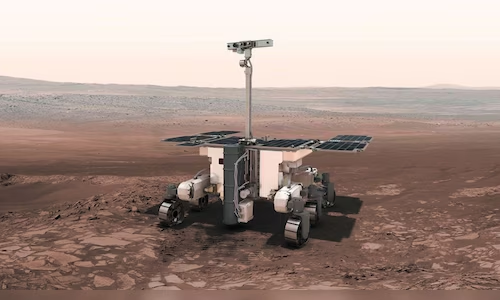
The mission itself is being led by the European Space Agency (ESA), which is responsible for the spacecraft, including the carrier module, landing platform, and the rover’s operations on Mars.
NASA’s role is to provide essential hardware and services through the ROSA project. This includes launch support, braking engines required for landing, and radioisotope heater units that will help keep the rover operational in Mars’s extremely cold conditions.
NASA will also contribute a mass spectrometer to analyze samples collected from beneath the surface, searching for organic molecules — the basic building blocks of life.
The rover is expected to land in a region called Oxia Planum, which scientists believe may once have contained water.
The two agencies strengthened their collaboration in 2024 by signing an agreement to expand work on the mission.
“Later that year, the KDP-A/B review approved ROSA’s formulation start in Phase B, and the project successfully met all the success criteria of its Preliminary Design Review,” NASA said.
For launch, NASA has selected Falcon Heavy, developed by SpaceX, which will lift off from Kennedy Space Center in Florida. The current target is to launch no earlier than late 2028.
Why Rosalind Franklin Stands Out Among Mars Rovers
The Rosalind Franklin rover is capable of drilling much deeper than any previous Martian rover.
Tests using a twin model of the rover on Earth have already demonstrated that it can drill to a depth of around 1.7 metres. Scientists believe this capability could allow access to well-preserved organic material dating back approximately four billion years, when Mars had conditions similar to those on early Earth.
Who Was Rosalind Franklin?
The rover is named after Rosalind Franklin, a pioneering British chemist and X-ray crystallographer whose work played a crucial role in uncovering the structure of DNA.
Her famous X-ray diffraction image, known as Photo 51, provided key evidence that enabled scientists to identify DNA’s double-helix structure — a breakthrough that transformed understanding of how genetic information is stored and transmitted.