


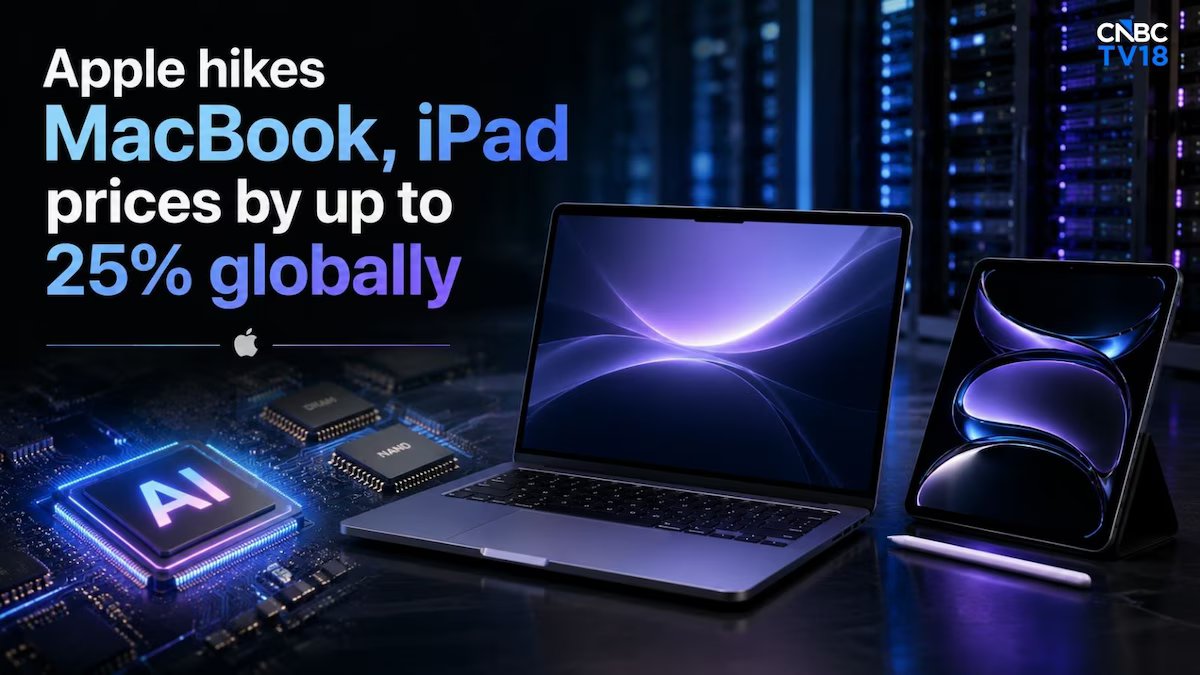
The global price hikes, announced on Thursday, apply to the MacBook Neo, MacBook Air, MacBook Pro, iPad Air and iPad Pro, while iPhone prices remain unchanged.
“The rapid expansion of AI data centers has created an extraordinary surge in demand for memory and storage,” the company said. “We know this is not welcome news, and we are working tirelessly to find solutions.”
Read more: Apple Under Tim Cook: 20x jump in market cap, quadruple sales and more
The entry-level MacBook Neo now starts at $699, up from $599, while the MacBook Air is priced at $1,299 compared with $1,099 previously. The 14-inch MacBook Pro now starts at $1,999, up from $1,699.
| Products | Previous Starting Price | New Starting Price | Price Hike |
| MacBook Neo | $599 | $699 | 17% |
| MacBook Air | $1,099 | $1,299 | 18% |
| 14-inch MacBook Pro | $1,699 | $1,999 | 18% |
| 11-inch iPad Pro | $999 | $1,199 | 20% |
| ipad air | $599 | $749 | 25% |
Apple has also increased the starting price of the 11-inch iPad Pro to $1,199 from $999, while the iPad Air now begins at $749, compared with $599 earlier.
In India, the MacBook Air now starts at ₹1,49,900, up from ₹1,19,900, while the MacBook Neo has been repriced to ₹79,900 from ₹69,900. The MacBook Pro M5 now starts at ₹2,39,900 compared with ₹1,69,900 earlier, while the 11-inch and 13-inch iPad Pro models have been increased to ₹1,39,900 and ₹1,99,900, respectively.
The move marks one of Apple’s broadest product price increases in recent years. Historically, the company has largely limited price revisions to new product launches or specific markets rather than implementing simultaneous global increases across multiple product categories.
Chief Executive Officer Tim Cook had earlier warned that price increases this year would be “unavoidable” because of what he described as the “unsustainable” cost of memory and storage.
Apple said it had so far absorbed much of the increase in memory and storage costs, but those costs have continued to rise to unprecedented levels, leaving it with little choice but to pass on part of the increase to customers.
Also read: Apple marks 50 years, celebrates 2.5 billion devices and garage-to-global journey
The memory crunch has been driven by massive investment in AI infrastructure, with chipmakers increasingly prioritizing production of high-bandwidth memory (HBM) used in AI servers over conventional DRAM and NAND memory used in consumer electronics.
The company had previously avoided raising prices despite supply chain disruptions during the COVID-19 pandemic and tariff-related uncertainty in recent years. The latest move underscores how the AI infrastructure boom is reshaping costs across the consumer electronics industry.
Apple joins a growing list of technology companies that have increased prices because of rising memory costs. Laptop makers Dell, HP, Lenovo and Asus have already flagged higher prices, while Samsung recently raised prices of two Galaxy S26 smartphone models in the US.
The global memory market is dominated by Micron Technology, SK Hynix and Samsung Electronics, which have benefited from surging demand for AI-focused memory chips as hyperscalers such as Google, Meta and Amazon expand their AI infrastructure.
Despite the broad-based increases across its Mac and iPad portfolio, Apple did not announce any changes to iPhone pricing, with the smartphone continuing to account for roughly half of the company’s revenue.